
Mus005 | Drawing from Memory
To draw from memory, strictly from memory, is an act of paying attention to the mind. You must ruthlessly recall an image or in the case of a portrait; the subject’s likeness, while blocking out all other thoughts and then attempt to capture that visualization with marks on paper. If the purpose of the piece is aesthetics and accuracy then this is going to be a challenge for even the best draftsmen*.
For a finished work to have both accurate and aesthetic qualities it depends on how well the draftsman knows the subject, and how well they can capture that knowing. The latter is a question of skill, the former a question of attention and recall. For myself, when I have attempted this practice, what results is an act that is both incredibly fun and deeply difficult.
Why does the final piece depend on both the knowing and the skill? If for example, you remove the fundamental component at hand, the memorization, and take a situation where you have a photograph of the subject as reference. Then the final drawing from the photograph will only be as accurate and aesthetic as the draftsman’s skills allow (commonly referred to as their draftsmanship). This is indisputable. The added layer, and the part which is the enjoyable challenge, is having to also conjure the starting image in your mind. If you cannot do that accurately, it does not matter how strong your draftsmanship is, the final piece might be aesthetic, but it will not be accurate. And to be clear, when I say accuracy, what I mean here is likeness; does the object look like the subject. You cannot draw what you cannot see - whether in reality or in your mind's eye.
As you begin a drawing in this way, you immediately start to investigate how well you actually know the subject. How well do you really remember this person’s features. If you try to recall, even someone you see frequently; a spouse, parent, friend, child, how well can you recall their specific form? Can you recall how the bottom of their earlobe attaches to their jaw, or the precise shape of their eyebrow and how far above their eye it is placed, or how about the simple arc of the jawbone? Drawing from memory forces you to put down answers to questions where your mind has only gaps. If any of these details are even slightly off, the likeness will not be there. When we have to draw these things we are intensely investigating how well we actually know a person, how well do we intimately know their specific appearance.
Even my own wife, through six years of marriage, the person I observe the most, trying to recall her exact features is still a challenge to me. It makes me question how well I pay attention to the forms of her figure and the planes of her portrait. It is one thing to look at a drawing and know it is off, it is another thing entirely to know how to fix it.
When considering the vast array of skills that make up draftsmanship there are a few that are particularly relevant to drawing from memory, especially when it comes to portraiture. Much like drawing from imagination, for success it is necessary to have studied from a wide variety of types. Personally I struggle here. I have not explored enough subjects with varying age, race and gender. As an example I have not drawn many old Korean females, nor have I drawn many young Australian Aboriginal males. Both of these would be insanely difficult for me to draw from memory; even if say, I met a person and tried to recall their likeness the following day. This is not a skill that I have sufficiently developed for a successful drawing and so it limits what I can achieve in a finished piece.
To draw from memory there are several ways to start off. You could look at the model or reference for some time before beginning the piece, not returning to the reference until the drawing is done. Or you could start with absolutely no beginning reference at all - just the memory of the subject as it exists in your mind. I have preferred to work with the latter. Practically, I do not always have a reference photo of the subject, but it also allows for more creative freedom of expression. Doing it in this way means you are always engaging with the subject through the blur of time, imagining past encounters and conjuring aberrations that match your memory - this is memory. Often it is this recollection that I find so captivating and enjoyable. It puts me back into the past and with it, the moods and emotions associated with that memory spill to the forefront of my mind.
You cannot truly know how hard it is to draw accurately from memory until you sit at the drawing board and try. Here I did, and thoroughly found out. The finished piece looks nothing like the subject, and it took a few attempts to even get here; through frustration and enjoyment.
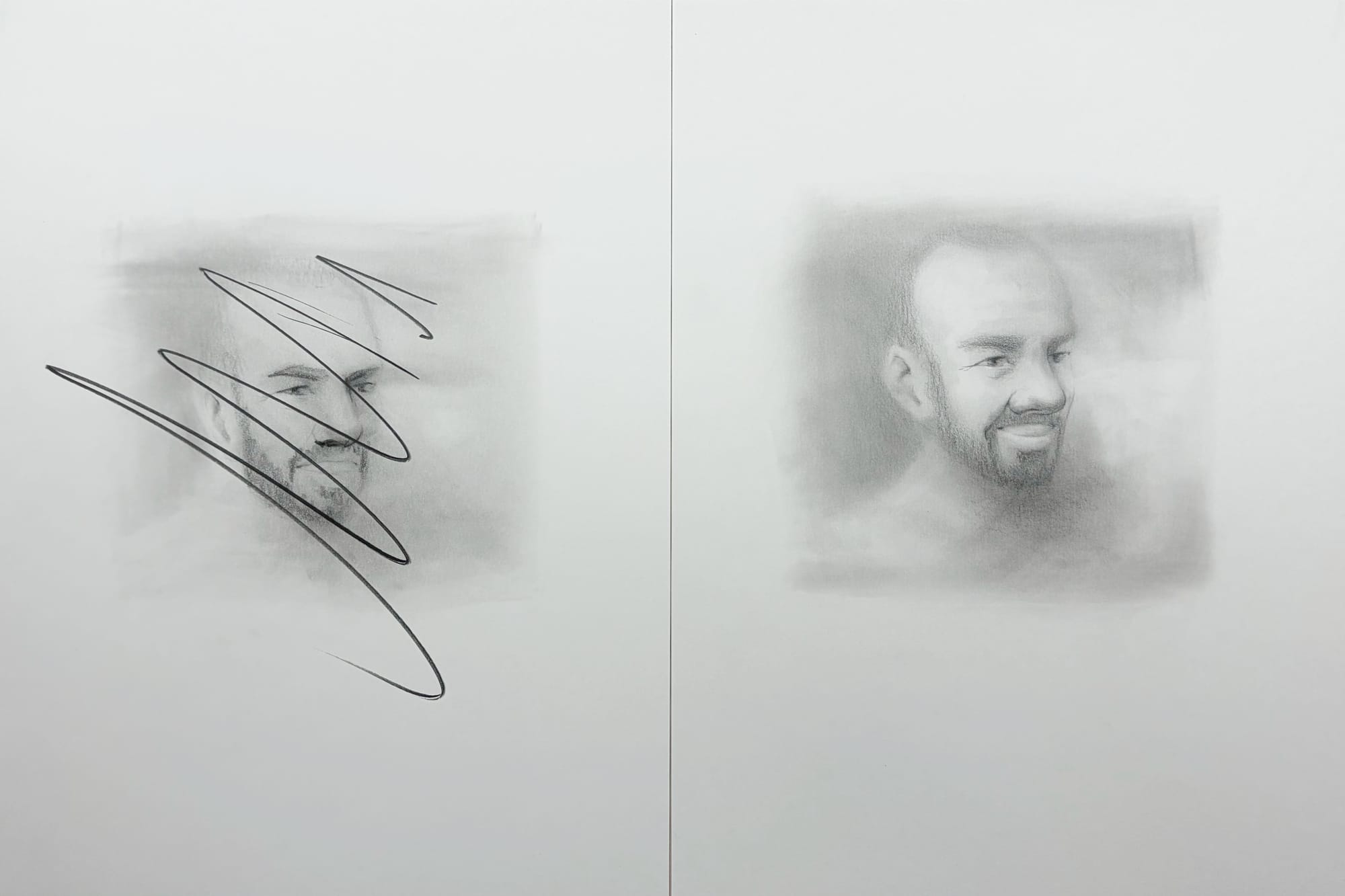
In future, I hope to draw many more finished pieces from memory. It is a great barometer of draftsmanship, it has a lot of translatable benefits to other areas of drawing, and ultimately I find the difficulty in the challenge to be enjoyable. Beyond the drawing it also helps you engage with how intimately you know a person, their appearance, and what makes them unique. This can have profound effects on your understanding of a relationship.
* A technical note: every time I talk about draftsmen what I really mean is draftsmen or draftswomen but in the efforts to maintain a sense of flow in my writing I have avoided such verbosity.